Pinayflix Video: Watch Free Filipino Entertainment Online
Pinayflix gives viewers a convenient way to watch free entertainment videos online. The website brings Filipino content, creator highlights, funny clips, performances,…
Read the guide →PinayFlix · Filipino films & series
PinayFlix is a streaming library of Filipino films and series, with an editorial guide attached — thousands of hours of drama, romance, comedy and horror, plus the context that helps you choose well instead of scrolling for forty minutes.
Most streaming sites are a search box and a wall of thumbnails. You open one, you have no idea where to begin, you click three posters that look like everything else, and you end up rewatching something you have already seen twice. PinayFlix was built to fix that specific frustration for people who want Filipino films and series without learning three new interfaces first.
The idea is simple. On one side there is a library: feature films, classic titles, independent work, and long-running series organised by mood and genre rather than by whatever the algorithm decided to push this week. On the other side there is this website, where we write about what is inside that library in plain language — what a title feels like to watch, who it is for, how long it takes, and whether it suits a Tuesday night when you have ninety minutes and no patience for a slow opening.
Everything is free to browse, and nothing here requires you to create an account before you can read a single sentence. There are no quizzes, no paywalls and no five-step funnel designed to capture an email address. If you only ever read one genre guide and leave, that is a perfectly good outcome; we would rather be useful once than exhausting repeatedly.
One honest note: availability moves around. Licensing windows open and close, and a title you loved last March can vanish from your region today. That is usually paperwork rather than mystery, and our disclaimer explains how we handle it and how rights holders can reach us.
Filipino entertainment is unusually wide, and most people only ever see the sliver that travels internationally. The library is arranged so that the other ninety percent is reachable without a film studies degree. Broadly, you will find four kinds of material.
Everything on PinayFlix falls into four groups. Contemporary features are the newest films: festival titles, mainstream releases, and the mid-budget dramas that never get a wide international cinema run but do extremely well at home. Series and teleserye are the multi-episode stories that Filipino television has perfected — usually between twenty and a hundred episodes, often broadcast nightly, always designed to give you a reason to come back tomorrow.
Classics and restored material cover roughly seven decades of filmmaking, from the studio era through the social-realist seventies and eighties to the digital independent boom of the 2000s. Some prints are pristine; a few are visibly worn, and we say so in our notes rather than pretending otherwise. Finally, shorts and independent work bring in newer voices — often the most inventive films on the site, and usually the shortest commitment you can make all evening.
There is a common assumption that cinema from the Philippines is niche, and that you need cultural context to enjoy it. In practice the opposite is true: the themes are almost aggressively universal. Family duty. Leaving home and feeling guilty about it. Love that arrives at the wrong time. Money that never quite stretches. A grandmother who is right about everything and says so. These are not exotic concerns; they are everybody's Tuesday.
What makes the storytelling distinctive is the emotional register. Filipino film and television rarely apologise for feeling things out loud. Grief is loud. Joy is louder. A reconciliation scene will take its time and earn its tears rather than slipping in an ironic joke to protect the audience. For viewers raised on extremely guarded Anglo-American drama, the first twenty minutes can feel like a volume knob being turned up — and then it becomes the reason you stay.
There is a practical advantage too. Dialogue-first stories survive subtitles better than action spectacles, because the plot lives in what people say to each other. Much of Filipino television is essentially theatre with a camera in the room, which is also why it works so well on a phone.
Genres are a promise about how you will feel in ninety minutes, which is more useful than a star rating. Here is how the main sections of the PinayFlix library behave, and who each one is really for.
If you only explore one corner, make it this one. Filipino drama ranges from quiet domestic portraits to multi-generational sagas, and the strongest titles put ordinary people under real pressure without letting them off easily. Expect long takes, strong performances and endings that are earned rather than tidy.
The genre most people arrive for, and the most often underestimated. Beyond the meet-cute there is a tradition of love stories built around distance — overseas work, long separations, families with opinions about your choices. Warm without being sugary, and quietly devastating about how timing decides everything.
Generous, fast, and built for a room full of people. There is a strong sitcom tradition and a real gift for ensemble chaos, so this is the section to open when nobody wants to commit to silence. Slapstick and wordplay coexist, and the subtitle teams keep the jokes intact rather than explaining them to death.
Practical, physical, and often shot on real streets rather than against a green wall. Thrillers here are tighter and nastier than the drama — crime, revenge, corrupt institutions — and they move fast enough to be a gateway if you think you do not like subtitled film.
The most distinctive corner of the library, and the one we get the most messages about. Filipino horror draws on a deep folk tradition rather than imported monsters, so you meet creatures and rules you have not seen a hundred times. The best entries unsettle rather than gore, and our folklore explainers exist because readers kept asking what they had just watched.
Gentler, broader, and the easiest place to start with a mixed-age group. Coming-of-age stories from provincial towns and crowded cities cover first love, first jobs and the ache of being the child everyone expects to fix things. Nothing here demands stamina.
Half of all viewing regret comes from choosing the wrong format rather than the wrong title. A brilliant series is a terrible choice at 11pm on a work night. Use this as a rough filter.
| Your situation | Choose | Why it works |
|---|---|---|
| Under two hours, one sitting | A feature film | Complete story, no cliffhanger debt |
| Tired, half-distracted | Comedy or action feature | Forgiving of a wandering attention span |
| A few episodes a week | Limited series | Short enough to finish, deep enough to invest |
| Watching with family nightly | Long-running teleserye | Shared routine, easy to catch up |
| Trying the library for the first time | A short or an indie feature | Low commitment, high surprise rate |
| Need to feel something | Family drama | The heart of the catalogue |
You do not need a history lesson to enjoy a film, but a little context makes the older titles legible. Here is the short version.
Chapter one: the studios. From the 1930s onward, Filipino filmmaking grew into a studio industry with stars, genres and production lines. Wartime interrupted almost everything, but the habit of a busy, audience-driven cinema was set early.
Chapter two: the golden age. The 1950s and 1960s brought craft, glamour and confident genre filmmaking, plus a star system that still shapes how people talk about the medium. This is where many of the classics here come from.
Chapter three: the angry years. Under martial law, filmmakers found ways to speak plainly about power, poverty and injustice, sometimes through allegory and sometimes not. This period produced the films most often cited in international retrospectives.
Chapter four: independent, digital, restless. Cheaper cameras and a festival culture that rewarded risk changed the economics of who could make a film. A generation of directors arrived with stories the studios had never wanted, and festivals started paying attention.
Chapter five: now. Streaming folded all of that into one library. A restored 1961 classic sits next to a series that premiered eight weeks ago, and a viewer can move between them in two clicks. That is new, and it is the reason a site like this is worth maintaining.
The teleserye is the engine of Filipino television: a nightly serial drama built to run for months, following several families whose lives tangle together through love, money, illness, inheritance and coincidence. Structurally it owes more to the radio serial than to the prestige television that dominates English-language coverage, and once you accept its rhythm it is enormously satisfying.
The craft lies in the pacing. Episodes are built around small payoffs — a confrontation, a reveal, a slap that has been coming for three weeks — while the long arc keeps stretching. Cliffhangers are not lazy here; they are the entire grammar of the form, and a good teleserye will give you a reason to press play tomorrow that has nothing to do with plot mechanics.
Treat it like a newspaper rather than a novel. You do not need to binge sixty episodes before you are allowed an opinion. Watch five: if the characters have their hooks into you, settle into a nightly half hour. If not, stop.
Decision fatigue is the real enemy of a good film night. This routine takes about four minutes.
Everyone's watchlist is a graveyard. The fix is boring but effective: keep it short, keep it ordered, and put something you are genuinely excited about at the top instead of the worthy documentary you feel you should watch. On PinayFlix, saving a title takes one tap on the library card.
We suggest a rolling list of five. Three films and two series, no more. When you finish something, you replace it. If a title has sat in position four for a month without being touched, it is not a priority — delete it and stop feeling guilty. Nothing about entertainment should feel like unpaid homework.
Filipino cinema mixes languages constantly — Tagalog, English, regional languages, and code-switching inside a single sentence, which is exactly how people talk. Subtitles are therefore not a compromise; they are a translation of a genuinely multilingual reality. If you are learning the language, subtitles are also the fastest classroom you will ever sit in.
Our default recommendation on PinayFlix is original audio with subtitles on. Dubs exist and some are good, particularly for younger viewers and for comedy, where a well-localised joke lands better than a literal subtitle. Try the original first, switch if it is not working, and do not let anyone make you feel bad about either choice.
If subtitles on a specific title are visibly out of sync, tell us through the contact page. We would rather fix a bad file than have every viewer assume the whole library looks like that.
Shared viewing needs slightly different rules from solo watching. The most useful habit is agreeing on the format before anyone presses play: a group committed to two episodes is much happier than one still negotiating at 9:40pm.
For a mixed group, choose the middle of the register: family drama with comedy in it, or a broad action film with a strong ensemble. Avoid anything that needs total silence unless everybody signed up for that.
With children in the room, check suitability first rather than trusting the poster. Filipino drama can move from warm family comedy to adult conflict quickly, and a series is not obliged to stay in one register across sixty episodes.
Playback problems on PinayFlix are almost always one of four things: bandwidth, browser, cache or a wrong setting. Before you write an angry message, work through them in that order, because three of the four take under a minute.
For long sessions, plug in. A phone that dies during the last ten minutes of a finale is a specific kind of tragedy.
You do not need a large television to get a good picture. You need to stop doing four things. First, turn off motion smoothing, which makes films look like behind-the-scenes footage and ruins pace. Second, pick the "movie" or "cinema" picture preset rather than the brightest one; it is closer to what the colourist intended. Third, stop watching in a room where the only light is a lamp directly behind your head. Fourth, sit closer than you think — most people watch from too far away and lose half the detail.
Calibrate expectations rather than equipment. Restored classics carry grain and softness because that is the source material, not your internet. We mention restoration quality in our notes so nobody spends twenty minutes troubleshooting film history.
Watching in a dark room on a bright screen is the most common cause of the "my eyes hurt, whose fault is this" message we get. Three adjustments help almost everyone. Reduce screen brightness well below what feels right at first — your eyes adapt in about five minutes and then the picture looks correct. Enable any warm or night-shift mode on the device. And put a small light behind or beside the screen so there is something in the room that is not the screen.
People who watch a lot of film are rarely people with more free time; they are people with a routine. Ours is unambitious and it works. One feature film a week, chosen in advance. Two or three episodes of a series on a fixed evening, so nobody has to negotiate it. One wildcard slot — a short, an indie, something from a genre you claim not to like.
That is roughly four hours a week and it will carry you through dozens of titles a year without ever feeling like an obligation. The wildcard slot matters most, because it is where taste actually develops. Twenty minutes of a documentary about a provincial theatre troupe will teach you more about what you enjoy than another sequel ever will.
Build in a fallow week too. A library is not a syllabus, and the point is that the good stuff is waiting when you have the energy.
There is a temptation to treat foreign cinema as educational, which is a fast way to make it feel like homework. A better frame, and the one the PinayFlix catalogue is arranged around: these films are a record of how a particular society argues with itself. The way a family talks at dinner, what people do when money arrives, which relatives have authority, what a wedding costs, who is expected to emigrate so everyone else can stay — you absorb all of it sideways, while enjoying a story.
That is why the library rewards wandering. A comedy from 1998 and a drama from 2023, watched a week apart, will tell you more about how the country changed than any summary. You start noticing which actors carry a scene and which directors keep coming back.
We add context when it genuinely helps, and never to flatten a film into a culture lesson. Watch first, read after.
Every note on this site is written by a human who watched the thing, and the language is deliberately plain. We say how long it is, what it feels like, roughly who it suits and what it might put off. We do not invent ratings to look authoritative, we do not pad descriptions with adjectives, and we do not call everything a masterpiece.
Where we are uncertain — an episode count that varies by region, a print that may differ from the original release — we say so instead of picking the tidier number. Where a title is genuinely divisive, we describe the divide rather than pretending it does not exist, because a paragraph that honestly explains why half the audience loves a film is more valuable than a glowing paragraph that sets you up to be disappointed.
If we get something wrong, the correction goes into the page, not a comment thread. Accuracy is cheap to maintain and expensive to lose.
The structure of PinayFlix is intentionally shallow. The homepage gets you oriented. The blog holds long-form pieces: genre explainers, seasonal watchlists, notes on individual titles and practical how-to guides. Category pages group articles so you can follow a thread without hunting. Every page uses the same header and footer, so the navigation never moves around on you.
If you know what you are looking for, search. If you do not, start with a genre and read one paragraph. The pages are built to load fast on a slow connection too, with no giant scripts holding up the text — you can read the entire article before a video would have finished buffering.
Some of the best additions to the PinayFlix catalogue come from readers. If a series from your childhood is missing, tell us the title and roughly what year it aired; the more specific you are, the easier it is to find. If a print is bad, if subtitles are broken, if a link sends you somewhere strange, one message is enough. We read everything, even when we cannot reply immediately.
We also welcome pushback on editorial. If we described a film as slow and you found it riveting, that is genuinely interesting — it means the description needs a second look at who it will land for. The contact page has the address, and a short, clear message gets a faster answer than a long one.
What we cannot do is host, sell or send files, or explain why a title is unavailable in your region today. Those questions belong with rights holders. We can tell you what exists, what it is like, and where the legitimate options are.
Films and series are somebody's work: writers, actors, crews, editors, sound designers, drivers, caterers. How PinayFlix treats that work matters, and so does how viewers treat it. Our position is simple and it is spelled out in the terms: we respect intellectual property, we respond to valid notices from rights holders, and we remove material when we are required to.
We also do not pretend that every title is licensed in every country. Availability changes, and a link that worked last month may not work today. If you are a rights holder and you want something removed or corrected, the contact address reaches a human who will act on it rather than a form that disappears into a void.
For readers the ask is modest: do not redistribute or re-upload, and support the people making the work where you can. Cinema in the Philippines has always been shaped by how audiences show up.
PinayFlix combines two words on purpose: Pinay, the familiar word for a Filipina, and flix, shorthand for films. It is a small name for a large archive — a place where Filipino films and series are treated as a proper catalogue rather than a curiosity at the bottom of a streaming app. If you searched for PinayFlix expecting a library and a guide, that is exactly what this is.
Written for readers who want a recommendation with reasons attached: no padded listicles, no 900-word introductions.
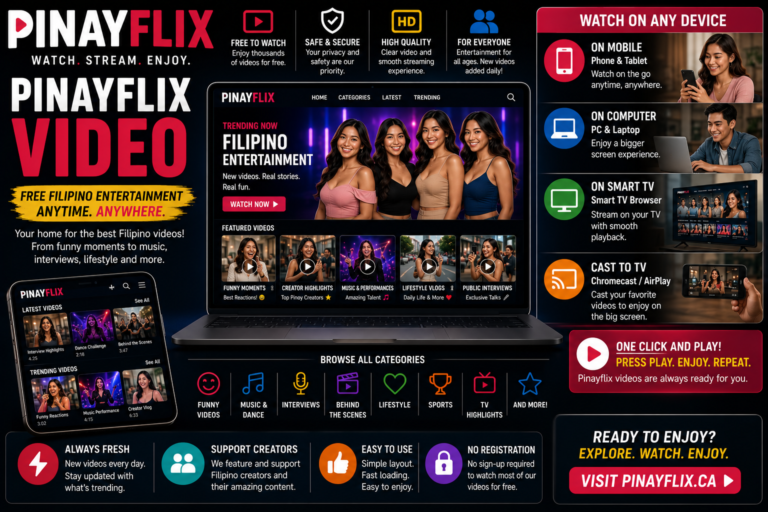
Pinayflix gives viewers a convenient way to watch free entertainment videos online. The website brings Filipino content, creator highlights, funny clips, performances,…
Read the guide →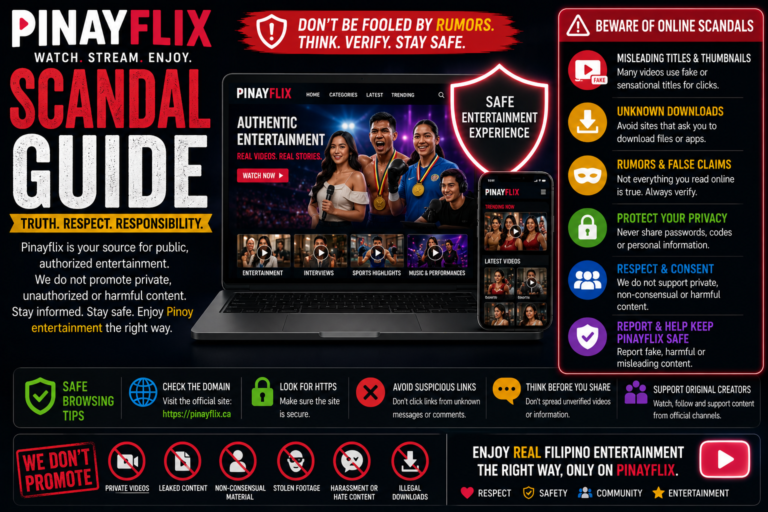
Pinayflix is an entertainment website created for viewers who enjoy Filipino videos, creator highlights, public interviews, performances and memorable online moments. Entertainment…
Read the guide →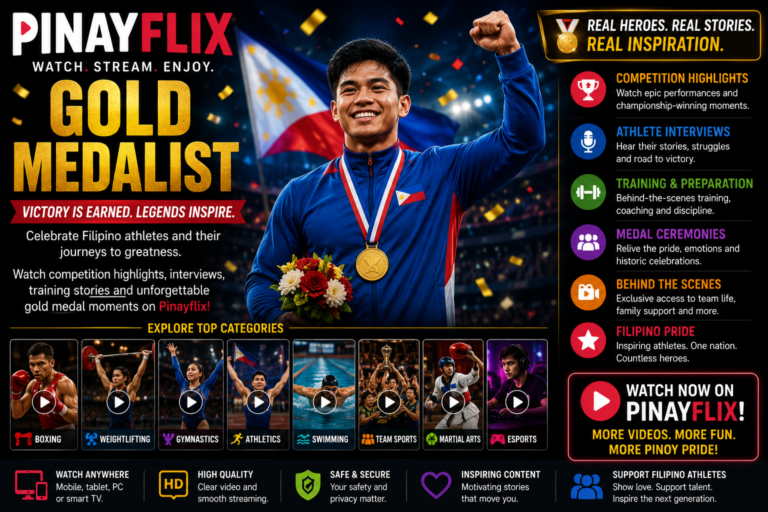
Pinayflix celebrates determination, discipline and unforgettable moments from Filipino sports. The Gold Medalist section brings together public athlete interviews, competition highlights, training…
Read the guide →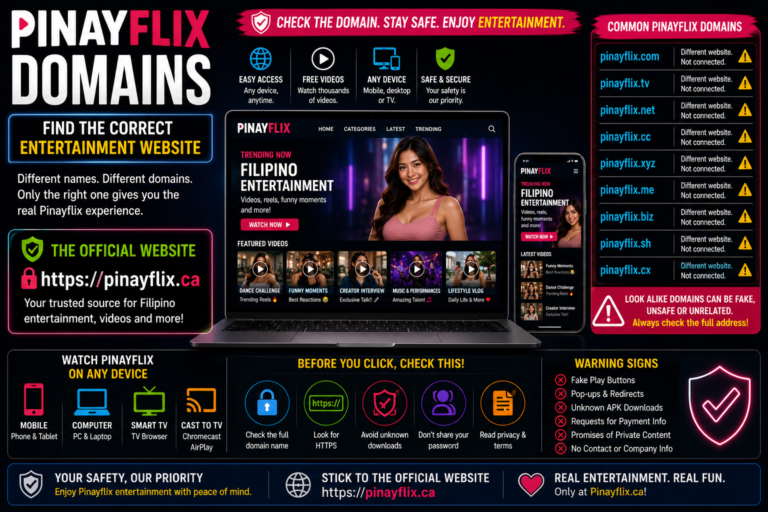
Pinayflix.ca is an online entertainment website where visitors can explore Filipino videos, creator highlights, funny moments, performances and trending content. People sometimes…
Read the guide →
Pinayflix Big 4 brings together authorized public entertainment involving four Filipino actors who became part of a widely discussed online story. This…
Read the guide →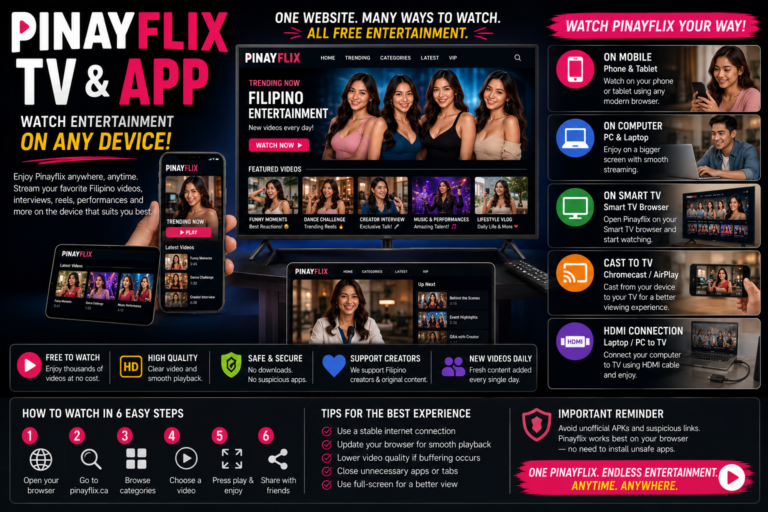
Pinayflix makes it easy to enjoy free online entertainment from the device that suits you best. Viewers can browse Filipino videos, funny…
Read the guide →PinayFlix exists because the hardest part of watching something good is usually choosing it. The library is the content; the PinayFlix guides are the map. Start with a mood instead of a genre, keep your watchlist to five titles, give a film ten honest minutes, and stop apologising for liking what you like.
If you have read this far and still have not pressed play, we have failed slightly, and the fix is easy: pick the shortest thing on the homepage and watch it tonight. Then come back and tell us whether the description matched the experience. That feedback loop — watch, react, refine — is the whole method, and it is why a library with a guide beside it beats an endless grid of thumbnails every single time.
Start here: browse a genre, read one paragraph, choose one title, and give it your full attention. That is the entire strategy.